AI teams often think usage-based billing starts with pricing plans or invoices.
It actually starts much earlier.
A reliable usage-based billing system first needs to know what happened, who consumed it, and how that usage should be interpreted commercially.
For most AI services, the architecture looks something like this:
AI activity
↓
Usage event
↓
Metering
↓
Attribution
↓
Cost calculation
↓
Pricing / rating
↓
Credits or billable units
↓
Plan limits + overages
↓
Invoice
↓
Profitability analysis
Each layer answers a different question.
Metering asks: What happened?
Attribution asks: Who caused it?
Costing asks: What did it cost us?
Pricing asks: What should that usage count as commercially?
Billing asks: What should the customer actually pay?
Keeping those questions separate makes usage-based pricing much easier to change, audit, and scale.
What does usage-based billing mean for an AI service?
Usage-based billing means that some or all of what a customer pays depends on measurable product consumption.
That consumption might be:
- Input and output tokens
- API calls
- AI credits
- Documents processed
- Agent runs
- Images generated
- Audio minutes
- Workflow executions
- GPU or compute usage
The important point is that the unit you meter does not have to be the same unit the customer sees.
For example, internally your system may record:
Input tokens: 4,200
Output tokens: 650
Model: Model X
Feature: document_summary
Estimated cost: $0.036
while the customer sees:
Document summary: 50 credits
That separation gives an AI company much more flexibility.
The technical system records what actually happened. The commercial system decides how that usage should affect the customer.
1. Start with a trustworthy usage event
The foundation of usage-based billing is the usage event.
A usage event is a structured record of an action that occurred inside the product.
For an AI product, a simplified event might contain:
{
  "event_type": "completion",
  "customer_id": "cus_123",
  "user_id": "usr_456",
  "provider": "provider_a",
  "model": "model_x",
  "feature": "document_summary",
  "input_tokens": 4200,
  "output_tokens": 650,
  "total_tokens": 4850,
  "estimated_cost_usd": 0.036,
  "timestamp": "2026-09-03T10:30:00Z"
}
The exact schema will vary by product.
What matters is that the event gives you enough information to understand:
What happened? Who used it? What resources did it consume?
This is the foundation of AI usage metering.
If customer identity, model, feature, or usage metrics are missing at this stage, reconstructing them later can become difficult.
2. Separate measurable usage from descriptive context
A useful event model distinguishes between metrics and dimensions.
Metrics describe quantities:
input_tokens
output_tokens
total_tokens
requests
latency_ms
cost_usd
gpu_hours
audio_minutes
images_generated
Dimensions describe the context around those quantities:
customer_id
user_id
workspace_id
provider
model
feature
request_id
environment
This distinction makes the metering system adaptable.
If your product later starts measuring GPU time, transcription minutes, or a new AI workflow, you should be able to add those without redesigning the entire billing architecture.
That flexibility matters because AI products rarely stay tied to one model, provider, or usage type forever.
3. Keep metering separate from the product action
A common early-stage implementation is to put billing logic directly inside the code that makes the AI request.
It may work initially:
Call model
↓
Calculate tokens
↓
Deduct balance
↓
Return response
But this becomes difficult to maintain as pricing gets more complicated.
A cleaner model is:
Customer uses feature
↓
Application emits usage event
↓
Metering layer records it
↓
Commercial rules process it
This gives the billing system a consistent stream of usage data rather than forcing every product feature to understand pricing logic.
It also makes it easier to support real-time ingestion, delayed processing, batch imports, backfills, and historical corrections.
Instrumentation should describe usage. Pricing should interpret it.
4. Attribute usage to the right customer
A model provider may tell you that your company consumed $10,000 worth of AI this month.
That is useful.
But it does not answer:
Which customers generated that $10,000?
Customer-level attribution changes the usefulness of the data dramatically.
Instead of:
Total AI cost: $10,000
you may be able to see:
Customer A: $1,800
Customer B: $620
Customer C: $85
Then you can go deeper:
Customer A
Document analysis: $1,050
AI assistant: $500
Agent workflows: $250
This makes the same usage data useful for billing, pricing, product decisions, and margin analysis.
Tracking cost per customer is particularly important for AI products because two customers paying the same subscription fee can create very different costs.
5. Understand the underlying cost
Before deciding what customers should pay, understand what their usage costs you.
For token-priced LLMs, that may involve separate input and output rates.
A simplified calculation might be:
Input token cost
+
Output token cost
=
Estimated model cost
But many AI products now combine several resources.
A workflow may use:
- An LLM
- Embeddings
- Retrieval
- An external API
- File processing
- Another model call
- Storage or compute
That means token usage alone may not represent the full cost of the product action.
LLM cost tracking helps connect model consumption to financial cost, while broader product metering can account for other resources as well.
The goal is not necessarily perfect accounting at the request level.
The goal is to have cost information accurate enough to support pricing, margin, and product decisions.
6. Add a pricing or rating layer
Metering and pricing are not the same thing.
Suppose the system records:
4,850 tokens consumed
That is usage.
Suppose the estimated provider cost is:
$0.036
That is cost.
The next question is:
How should this event count toward the customer’s commercial usage?
It might become:
50 credits
or:
1 document
or:
$0.10 billable usage
or simply:
Included in plan
That translation is the rating or pricing layer.
This layer is valuable because it lets the business change pricing without changing how every AI feature is instrumented.
Your application can continue measuring the same underlying usage while commercial rules evolve.
7. Decide what customers should actually see
For developer infrastructure, exposing tokens may make sense.
For many AI SaaS products, tokens are too technical.
A business customer usually thinks in terms of:
- Reports generated
- Documents processed
- Automations completed
- AI actions
- Credits remaining
rather than:
4,850 tokens
That is why many AI products use credits.
A possible flow is:
Raw usage
4,850 tokens
↓
Underlying cost
$0.036
↓
Pricing logic
↓
Customer consumption
50 credits
Engineering gets precise metering.
Finance sees cost.
The customer gets a simpler usage unit.
The tradeoffs between the two approaches are covered in AI Credits vs Tokens: Which Pricing Unit Should Your AI Product Use?
8. Treat credits as transactions, not only a balance
If your product uses credits, a single number such as:
Balance: 14,250 credits
is useful for the UI.
But behind that balance, it is valuable to preserve the events that changed it.
For example:
+20,000 Monthly allocation
-50 Document summary
-200 Research workflow
+500 Promotional adjustment
This makes the balance explainable.
Credits may be added or removed because of subscriptions, purchases, usage, refunds, promotions, adjustments, or corrections.
A transaction history makes it easier to answer one of the most important billing questions:
Why does the customer have this balance?
This becomes increasingly important as pricing becomes more sophisticated.
9. Connect usage to plans and entitlements
A pricing plan does more than define a monthly price.
It also defines what the customer is entitled to consume.
For example:
| Pro Plan | Starter Plan |
| $199/month 25,000 credits included Monthly reset Overage enabled | $49/month 5,000 credits included Hard limit No overage |
Metering tells you how much the customer has consumed.
The plan tells you how much they are allowed to consume under their subscription.
The enforcement layer decides what happens next.
10. Define what happens at the limit
A usage quota is only useful if the product knows what happens when the customer reaches it.
There are three common approaches.
| Hard limit | Usage stops when the allowance is exhausted |
| Soft limit | Usage continues but warnings or upgrade prompts appear |
| Overage | Usage continues and excess consumption becomes billable |
Different customer segments may need different policies.
For a self-serve product, a hard stop may be acceptable.
For an enterprise AI workflow, interrupting usage may be unacceptable, so overage billing or a negotiated limit may work better.
The important architectural point is that quota enforcement should be a business decision, not something hard-coded into raw usage collection.
11. Warn customers before they run out
Usage-based pricing works better when customers can see what is happening.
Useful signals might include:
50% of allowance used
80% used
90% used
Low credit balance
Overage started
This improves customer experience and can also create expansion signals.
A customer consistently approaching their limit may be ready for:
- A higher plan
- More included credits
- A usage commitment
- Enterprise pricing
Usage visibility is therefore both a billing function and a product-growth function.
12. Separate raw usage from billable usage
This is one of the most important distinctions in the architecture.
Not every usage event that creates cost should be charged to the customer.
Examples include:
- Internal usage
- Free trial activity
- Failed requests
- Retries
- Promotional usage
- Customer support adjustments
- Usage already included in the subscription
That means your system needs to distinguish:
Raw usage
↓
Metered usage
↓
Rated usage
↓
Billable usage
Only the final commercial result should feed invoicing.
This is what allows the company to make pricing decisions without corrupting the underlying usage record.
13. Design for events that cannot be priced
Real-world billing systems encounter events they do not immediately know how to handle.
A new model may appear.
A provider configuration may be missing.
A previously unseen event type may arrive.
A pricing rule may not match.
A dangerous system silently ignores these events.
Another dangerous system guesses.
A better architecture gives unresolved usage an explicit exception path so it can be reviewed and corrected without losing the original event.
You do not need to expose every internal detail of that process to customers.
But the architecture should assume that billing will sometimes encounter incomplete or unexpected data.
Reliable billing needs a failure path, not just a happy path.
14. Make billing explainable
Customers eventually ask questions such as:
Why was I charged this amount?
Why did my credits disappear?
When did my overage start?
Which usage caused this invoice?
If the answer cannot be reconstructed, trust in usage-based pricing deteriorates quickly.
That is why billing systems benefit from preserving the relationship between:
→usage event
→ pricing decision
→ customer consumption
→ invoice
You do not necessarily need to expose every raw technical event to the customer.
But internally, the path from usage to charge should be traceable.
15. Use the same data to understand profitability
Usage-based billing should eventually answer two different financial questions:
What should this customer pay?
and:
Is this customer profitable?
Suppose:
Customer revenue: $599
AI provider cost: $140
Other variable cost: $35
Gross profit: $424
Now compare that with another customer paying the same $599 but generating $500 in variable AI cost.
Revenue alone does not reveal the difference.
Customer-level metering makes it possible to connect revenue, provider cost, usage, and gross margin.
That is where billing data becomes business intelligence.
Our AI Cost Attribution guide explains how customer and feature-level cost attribution supports those decisions.
A practical AI usage-based billing architecture
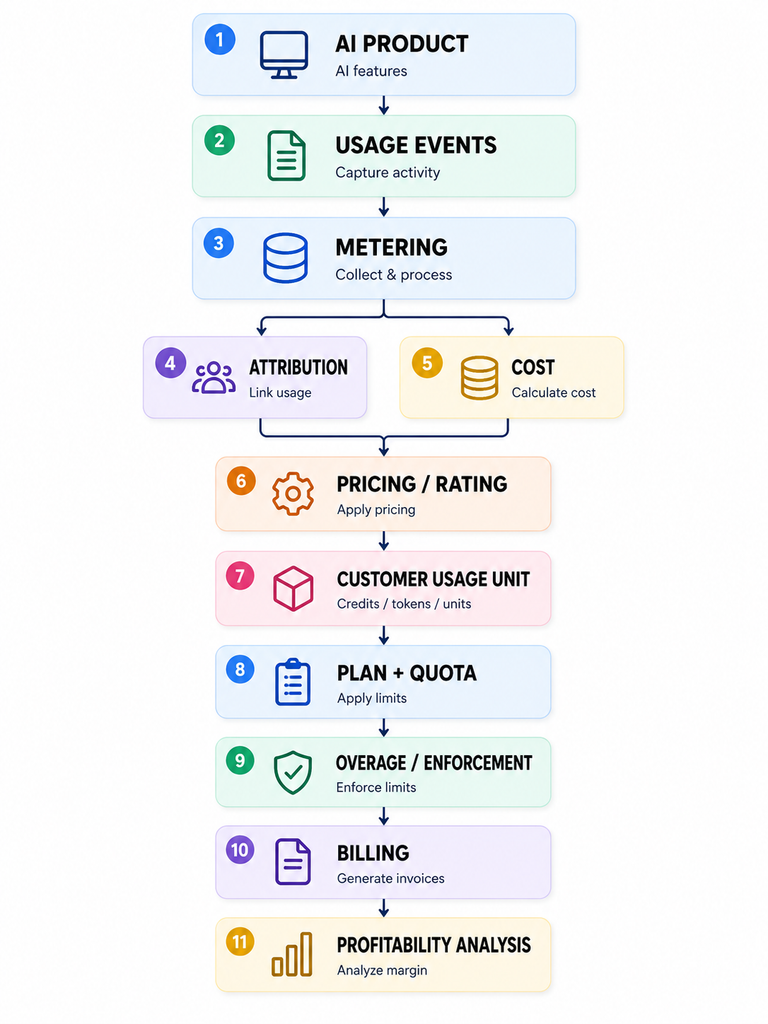
This architecture is valuable because each layer has a clear responsibility.
You can change your pricing without rewriting instrumentation.
You can change your model provider without redesigning your customer plans.
You can offer different commercial terms to different customers while preserving the same underlying usage record.
And you can explain why a customer was billed without trying to reconstruct history from provider invoices.
Common mistake: treating the payment provider as the metering system
Payment platforms are excellent at collecting money.
But they do not automatically understand what happened inside your AI application.
Your product still needs to decide whether:
6,000 input tokens
+
1,200 output tokens
+
2 model calls
should become:
80 credits
or:
$0.50 in billable usage
or:
Included in subscription
The payment system can invoice the result.
It should not be responsible for discovering the meaning of the underlying AI usage.
This is why AI Usage Metering: Why AI Products Need Usage Tracking Before They Need Billing argues for building a reliable usage layer first.
How MetricaOS fits into this architecture
MetricaOS is designed as the metering and monetization layer between AI product usage and billing.
It helps teams capture structured usage, associate it with customers and product context, understand provider and model costs, apply commercial usage logic, manage credits and plan allowances, handle overages, and analyze the resulting customer economics.
The MetricaOS application itself reflects these layers through areas for usage events and schemas, providers, credit rules, customer wallets, plans, analytics, invoicing, exception handling, and auditability.
The goal is not simply to count tokens.
It is to create a reliable connection between:
AI activity → usage → cost → customer consumption → billing → revenue
without forcing product teams to rebuild that infrastructure every time their pricing model changes.
Build the usage layer before billing becomes complicated
Early AI products can often survive with a few counters and simple plan limits.
But complexity tends to arrive quickly.
New models appear.
Provider pricing changes.
Customers request custom terms.
Credits are introduced.
Enterprise accounts want overages instead of hard limits.
Finance wants margin visibility.
Customers want usage explanations.
Pricing evolves.
The earlier the product has a reliable usage foundation, the easier these changes become.
The implementation order is therefore straightforward:
Capture usage accurately. Preserve customer context. Understand cost. Apply commercial rules. Then bill.
That separation makes usage-based pricing easier to operate today and much easier to change tomorrow.

Comments 0